

Travelling with bladder and bowel conditions can be a stressful process, and many will simply neglect the opportunity to venture across the world in fear that they won’t have fast access to a toilet. However, this doesn’t mean that you shouldn’t be able to enjoy the sight-seeing and fulfilment that others experience when abroad, so we’re here to offer you the best advice for travelling happily with bladder and bowel conditions.
If you live with a bladder or bowel condition and are planning a holiday, a trip for work, or perhaps travelling further afield for a longer adventure there is enough to plan without having to consider your healthcare needs. Living with an on-going bladder or bowel condition such as incontinence, crohn’s disease or ulcerative colitis, can make dealing with flare-ups difficult enough from the comfort of your own home.
The first thing to remember is there is no real reason why you can’t go away as long as you prepare carefully and plan everything in advance to make your trip more enjoyable and comfortable.. Below are some general tips to help you travel with confidence.
Travelling With Confidence
[BBC:042] Travelling with Confidence
This handy guide provides helpful hints and tips on travelling confidently with a bladder or bowel issue, available to download and reference later. A visual infographic is also available here.
Method of Transport
If you are travelling with IBS or a similar condition which means you need regular access to a toilet, then it’s crucial to pick a method of transport that includes a toilet – it may sound obvious but there’s no point in booking a coach trip if there’s no toilet on board.
Flying with Confidence
If you’re flying it may help to book a seat near the toilets and plan your flight time with your bowel habits in mind. You may need certificates for any medication you carry, and ensure you follow the airline’s guidelines for how these should be packed and transported.
In the UK if you are travelling by air with a disability or reduced mobility you are legally entitled to support – known as ‘Special Assistance’ – provided by airlines to ensure you have a less stressful journey.
You should be offered help from your arrival at the airport – this applies to all UK airports – and supported throughout your journey through the airport, in the air, and through arrivals at your destination airport.
Special Assistance support can include:
- your journey through departures
- boarding the aircraft and during the flight
- disembarking the aircraft
- Any transfers between flights
- travelling through your destination airport
You must give the airline 48 hours notice if you plan to request Special Assistance.
Travelling by Car
If you plan on travelling by car then make a note of where the service stations are. Watching what you eat and drink on the day of travel can also help avoid an overactive bladder or upset bowel. You may wish to take easy to store foods with you, as motorway services may have a limited selection of refreshments if you’re following a special diet. This is a great way to travel if you can plan frequent stops, to stretch your legs and use the toilet.
You might also wish to use a lease car, with companies such as the Motability Scheme offering cars, Wheelchair Accessible Vehicles, scooters and powered wheelchairs to people in exchange for their mobility allowance. To be eligible for the scheme, you must be in receipt of certain benefits. You can find out if you’re eligible by visiting Motability Eligibility.
The Great British Toilet Map is a community initiative which can help you find a toilet when you’re on the go. You can also add your own locations to help others along the way. Visit the Toilet Map website for more information.
Travelling by Public Transport
If you live in England and are ‘eligible disabled’ you can apply for a disabled person’s bus pass via your local council, which entitles you to concessionary travel. There are similar schemes in Scotland, Wales and Northern Ireland.
If you are a disabled person and travelling by bus or coach, by law drivers must give ‘reasonable assistance’ to help ease your journey, for example helping you embark or disembark the bus or coach. It’s worth asking for assistance in advance if you’re planning to travelling on a coach, and might need extra help.
Healthcare Abroad
If you’re a UK citizen travelling in Europe make sure that you’re equipped with a Global Health Insurance Card (GHIC) – this is replacing the European Health Insurance Card (EHIC), which can still be used if still in date. Carrying it with you means you’ll be able to access healthcare for the same cost as residents of that country, otherwise you’ll have to pay in full. You will also need Travel Insurance though, as this is specific to healthcare.
Non UK citizens may need to check eligibility, for more information see the NHS information about Healthcare Abroad. Do check for any exceptions, as some destinations may not accept the GHIC or EHIC.
Travel Insurance
Remember to sort out any insurance cover before you pay for your holiday. This particularly applies to anyone with a pre-existing condition such as (but not limited to) Crohns & Colitis, Cancer, IBD. It’s worth looking at insurance options available and being upfront about your condition before you part with any money as it could be difficult to get a holiday refund if you are subsequently refused insurance on health grounds.
Finding a suitable insurance company is the first step. Money Helper provides a directory of insurance providers who cover pre-existing conditions – this is provided by the UK Government Money and Pensions Service to ensure anyone going on holiday can afford suitable healthcare during your time abroad.
Be sure to disclose details of your health condition or you may not be covered. Find out more about insurance for pre-existing conditions in our resource section.
Doctor’s Letter
Ask your GP to provide or help you with the following:
- A letter outlining your medical history and explaining your need and use of medications, devices or appliances etc. It’s advisable to keep your medicine in its original packaging to show at customs. This letter will also help if you need to get a prescription whilst away.
- A written management plan outlining what you should do for mild, moderate and /or severe symptoms, and when you should seek medical attention.
- Make sure you are able to take enough of your normal medication, devices or appliances to last the duration of the trip.
- A contact number for your GP in case you need medical advice while you are away. It can be very reassuring to know that you can call your GP if you have any medical problems.
What to pack
Packing can always be tricky, especially when you need to carry medications and prescription supplies with you. Be sure to check with your airliner or chosen method of transport to see what luggage you can take, and how you should pack these important items.
We’ve created a useful ‘Desert Island Kit’ infographic which you can keep handy, so that when it comes to the exciting (but for some) stressful part of the packing process, you can make sure you have the essentials.
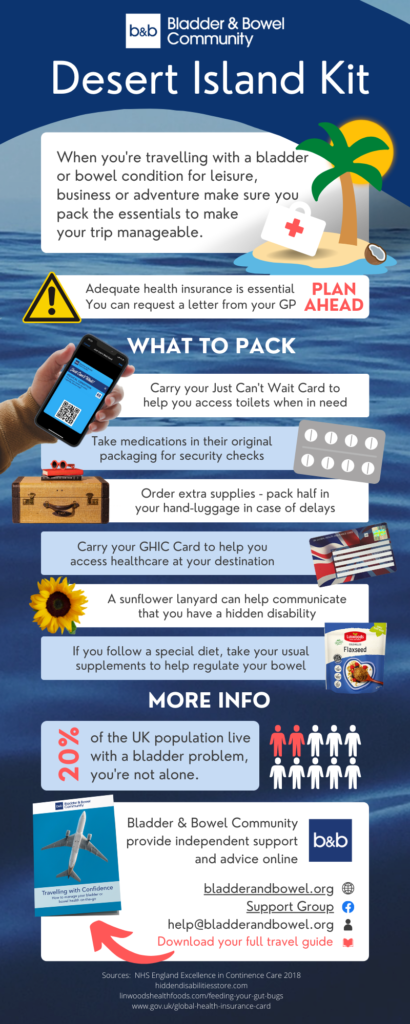
Please feel free to share this infographic
When it comes to packing pads, pants and wipes, you can never pack too many. There’s nothing worse than realising you’re short of supplies, so bring as many as you feel reasonable for the duration of your journey.
You can obtain a Sunflower Lanyard which can help communicate that you have a hidden disability. These are available to purchase from Hidden Disabilities, and can be picked up free in participating venues which now include some airports and large stores. You can find more information about travelling with the sunflower in this article.
Supplies
Check with your supplier before you travel to see what support services they may have, as some manufacturers and home delivery suppliers have special cards in foreign languages that are extremely helpful if you use prescription continence or stoma appliances.
The best policy is to take a good supply of all the items you will need – pads, pants, creams, wipes, etc. It also pays to pack some of your supplies in your hand luggage in case of delays or lost luggage. You’ll need to check with your airline and keep within their guidelines for carrying equipment and medicines.
Our Bladder & Bowel Home Delivery Service can help you manage supplies, through a friendly, reliable and discreet supply service. Please visit the Home Delivery Service section for more information.
Bed Protection
Ask if this can be supplied at your chosen accommodation or take a generously sized waterproof sheet or pad with you – thin disposable draw sheets with a leak proof backing are available.
Hygiene and Laundry
It’s advisable to take your own disposal bags and a few bin liners for used pads, etc. A deodorising spray may also help. Remember to check what facilities are available with your accommodation before you book; an en-suite bathroom is an obvious choice.
Most large hotels should provide laundry services; an extra charge may be required. Or take washing detergent and a portable washing line with you for smaller items.
Luggage
When flying, remember to split up your supplies between different bags, in case one is lost! Also, pack all the items you are likely to need during the flight and waiting periods at each end in your hand luggage. Most airlines allow extra hand luggage for medical reasons so don’t be afraid to ask when you book.
You will need a medical letter from your GP for airport security if you have essential medical equipment or your products are in excess of the security cabin baggage allowance (eg, skincare). Currently, containers must be 100ml or less and packed in one re-sealable plastic bag (20 x 20 cm). Please seek advice from your airline when you book or check current Government guidelines.
Public Toilets
Public toilets are few and far between in some countries. It can be easier to find a toilet in a hotel, bar or restaurant, or in a shopping centre. Carry a supply of disposal bags and wipes etc. when you’re out as bins and hygiene can also be a bit hit and miss.
Don’t forget your Just Can’t Wait toilet card; it states the holder has a genuine medical condition that may require the urgent use of a toilet. You can apply for a Just Can’t Wait toilet card to help you communicate clearly to others that you need to use a toilet without delay. Get yours FREE today.
A RADAR key which gives access in the UK to 9,000 locked toilets for disabled people, may also prove useful. Germany and some other European countries have a similar scheme through CBF Darmstadt – visit their website for details.
Diet
Wherever you’re going stick to your usual diet if possible and when abroad avoid eating washed salads and fruit, adding ice cubes in drinks or eating food that has been reheated or left sitting uncovered on a food counter. Drink only bottled water and make sure you drink enough fluids to remain hydrated (6 – 8 glasses a day or between 1.5 – 2 litres).
If you follow a special diet, you may wish to take some familiar foods with you. For example, if you’re coeliac and visiting a country where it may be difficult to find gluten free foods, you might take some bread or crackers just in case. Similarly, if you take dietary supplements such as hemp or flaxseed, these can be transported in their original packaging and tucked into your suitcase.
Relax and Enjoy!
Opportunities for travel have grown significantly in recent years, with cheaper flights serving a wider range of destinations and more accessibility within rail and bus stations. For many people, this has made travelling a more common experience. It is a matter of equality that disabled people and people with reduced mobility should have opportunities for travel comparable to those of other people. However, for people with a disability or mobility difficulty, the prospect of attempting a trip by air can seem fraught with potential difficulties.
Travelling with bladder and bowel conditions doesn’t have to be a recipe for disaster. The best thing you can do is to plan ahead, and be prepared for dealing with unexpected delays or circumstances which at times cannot be avoided. Ask for help when you need it, and remember to try to relax and enjoy your trip!
We hope you’re able to travel a little happier with this advice – let us know your experiences at [email protected].
Further Help & Information
For more information about travelling with confidence please visit our downloads section. This contains more helpful advice and tips, as well as the contact details of organisations that may be able to help you further.
Travelling with a Disability – Visit the Civil Aviation Authority website for more information about your rights and air travel as a UK citizen: https://www.caa.co.uk/
Global / European Health Insurance – Apply for, or renew your GHIC or EHIC via the NHS website.
UK Travel – If you’re travelling within the UK find our more about your right to support as a disabled person: https://www.gov.uk/transport-disabled/cars-buses-and-coaches
Get Support – Sometimes the most valuable advice can come from those who have experienced the same situation. Help is available to you in our Closed Facebook Support Group. This is a global community accessed from around the world – so if you have any travel questions or concerns, or can offer any help or advice please share your thoughts in the Bladder & Bowel Community Support Group.